
Adaptations for life in the sea
An adaptation is a change that makes an animal more suited to life in its environment.
Penguins are well designed for obtaining food and water, swimming and keeping warm in the sea.
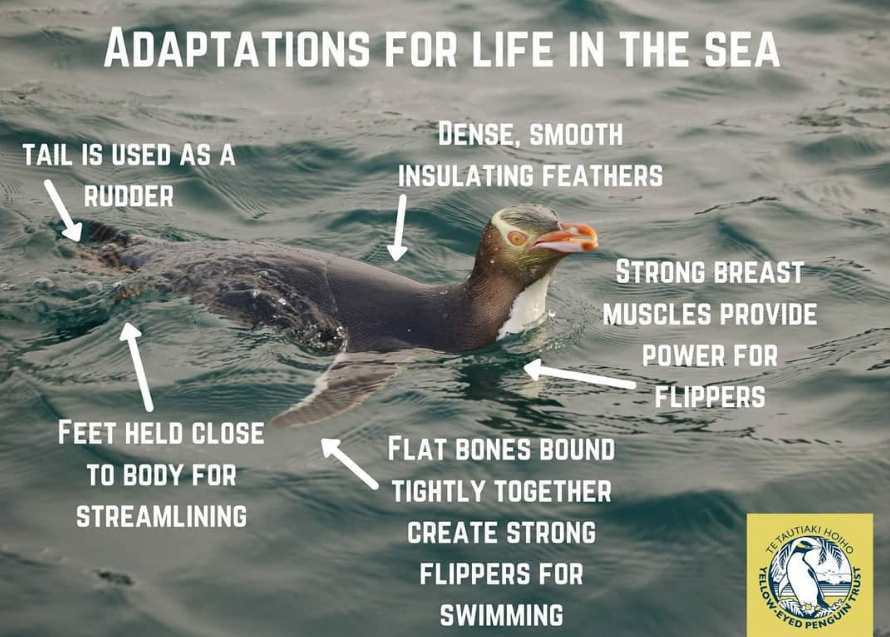
Heavy, solid bones
These act like a diver’s weight belt, allowing them to stay underwater.
Paddle-like flippers
The wings are modified into flattened broad bones with the joint of the elbow and wrist almost fused. Penguins flap their flippers to propel them through the water at speeds up to 20 km per hour.
Short wedge-shaped tail
Used as a prop on land or when climbing from the shore across rocks and up steep cliffs.
Strong legs with webbed feet
The legs are set far back on the body to help streamline the bird and steer while swimming. This placement also causes penguins to stand vertically and walk upright.
Long thin bill
The powerful bill is mainly used to catch food such as fish and squid. It is also used to preen feathers and to defend themselves from predators or other birds. The mouth and tongue are lined with backward pointing spines to hold the slippery fish until it is swallowed whole.
Special feathers
Penguins have many feathers to keep them warm in the sea by providing a waterproof insulating layer. Two layers of short, stiff and hooked feathers lock together, trapping a layer of air between the skin and the feathers. Underneath the outer feathers is a layer of down. Preening helps keep the feathers clean and well oiled. There is an oil gland at the tip of the tail – the bill is used to spread the oil through the feathers.
Blubber
Penguins have a layer of blubber, or fat, under the skin to help keep them warm.
Salt glands
These are located just above the bill between the eyes. They remove the salt from seawater and fish, which is then excreted from the bill.
Keeping cool
Penguins are able to cool themselves by flushing blood through their flippers and feet. This is why penguin’s feet turn bright pink on warm days. When they are really hot they pant!
Colour
All adult penguins are counter-shaded – dark on the back and white on the underside. This is often thought to be for camouflage – the dark side blending with the dark ocean depths when viewed from above, and the white side blending with the lighter surface of the sea from below. Other theories have also been proposed including thermoregulation (the dark side faces upwards and absorbs heat from the sun to warm them) and social signalling (for attracting other penguins).


